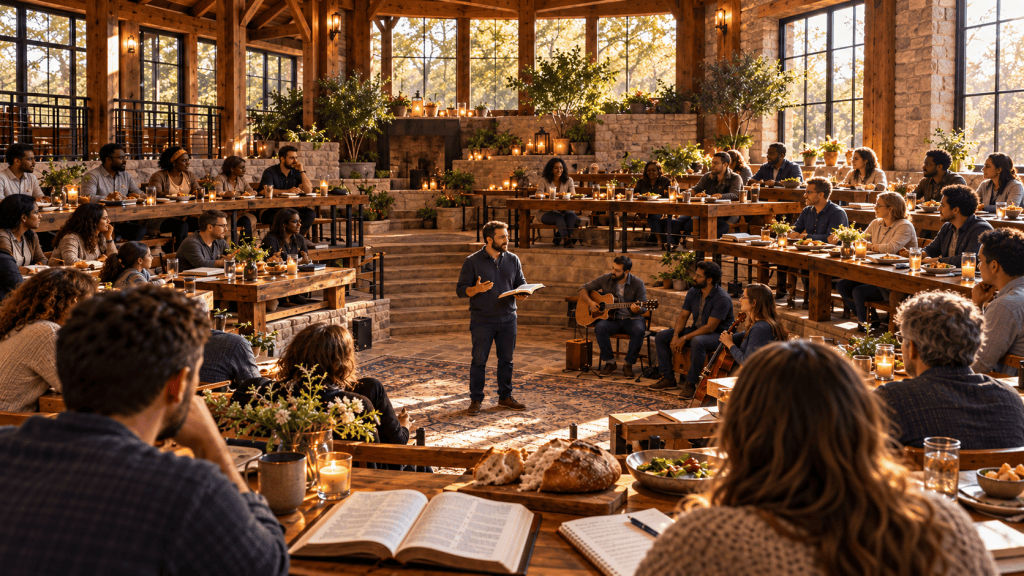
Two years ago, God gave me a vision of a church.
The room was filled with levels of tables where people could sit, take notes, open their Bibles, and break bread together. The pastor was teaching from a central pit, on the floor among the congregation. The worship team was there too.
The arrangement made something clear: the pastor was not held higher than the people. The congregation was not being placed above the pastor either. The room drew our attention toward what we had gathered to receive—the Word of God.
People could see, hear, consider, and participate. The pastor’s stage presence was not the center of gravity. Scripture was.
I have carried that picture for two years. I believe we are coming close to walking that vision into reality and mission.
I also believe it is an invitation worth bringing to the Church across the United States. This vision deserves prayer, collaboration, biblical examination, and the willingness to ask a difficult question:
Should we look at this?
Have our gatherings helped people become a living body, or have we become too comfortable keeping them an audience?
I believe God is calling us to consider a church where the Word is central, hospitality is practiced, worship answers God, and ministry belongs to the body.
Its heartbeat is this:
We receive one another at the table.
We hear God speak through Scripture.
We wrestle with the Word together.
We respond to God in worship.
We minister to one another in prayer.
We are sent back into the community.
We begin in prayer. We conclude our gathering in prayer. Everything between those prayers should help form people who carry the life of Christ into the world.
Why this vision matters
There are faithful churches doing beautiful work. There are pastors serving sacrificially and believers caring for neighbors whose names will never appear in a ministry report.
We honor them.
But we must also tell the truth about places where the church has missed it.
Too often, we have built a weekly experience that people can enjoy without becoming meaningfully connected, spiritually equipped, or accountable for how they live.
The music moves them. The message encourages them. The closing moment reassures them. They leave with three helpful points and a feeling that something important happened.
Meanwhile, nobody knows their marriage is collapsing.
Nobody knows the refrigerator is empty.
Nobody knows they have been sitting in the same room for six months wondering whether anybody would notice if they stopped coming.
But the transitions were smooth.
We should be disturbed by that.
A church can have excellent production and poor shepherding. It can preach community while making almost no room for people to become known. It can celebrate generosity while failing to recognize needs sitting ten feet from the offering basket.
We have sometimes settled for a TED Talk with music and called it discipleship.
Jesus calls people into a life that reaches their anger, money, relationships, speech, sexuality, work, and treatment of enemies.
We need gatherings that help us follow Him into those places.
If our faith consistently leaves us inspired but unwilling to repent, something needs attention.
If someone must die before the church discovers they were lonely, our attendance system has outperformed our pastoral care.
We can do better.
This vision asks us to build around the formation of a people who know Christ, know one another, and become useful to their neighbors.
Acts 2 gives us the foundation
Acts 2 begins with God moving.
The Holy Spirit comes. Jesus Christ is proclaimed. People are confronted with truth, called to repentance, and baptized.
That is our foundation.
This church exists because Jesus was crucified, rose from the dead, and reigns as Lord. Salvation comes through His grace. Hospitality cannot accomplish what His death and resurrection accomplish.
An excellent casserole has limits, regardless of what the church cookbook claims.
But receiving Christ produces a shared life.
In Acts 2:42–47, believers devote themselves to the apostles’ teaching, fellowship, the breaking of bread, and prayer. They share resources, respond to needs, gather publicly and in homes, eat with gladness, and praise God.
Their faith reaches their tables and possessions.
We should take that whole picture seriously.
Teaching grounds the body in truth. Fellowship gives belonging practical expression. Breaking bread creates room for shared life. Prayer acknowledges dependence on God. Generosity responds to the needs among them.
We cannot celebrate the preaching in Acts while treating the community it forms as an optional upgrade.
The early Church also faced dishonesty, conflict, neglected people, and difficult decisions. This model will require correction and responsible leadership.
Tables do not cure human nature.
The Holy Spirit forms people who can repent, reconcile, share, and persevere. We intend to give those practices room.
We want devotion that means more than regularly occupying a chair.
Jesus gives us the tone
Jesus teaches in homes, synagogues, along roads, beside the water, on mountainsides, and around tables.
He speaks to crowds and individuals. He asks questions, receives interruptions, and teaches through ordinary things: bread, fields, money, families, workers, and meals.
He meets people where they live and reveals what they need to understand.
His nearness carries authority.
He welcomes sinners and calls them to repentance. He comforts the grieving and confronts hypocrisy. He receives children and unsettles people who confuse religious status with righteousness.
That tone should shape us.
People should be able to come without knowing church vocabulary. We will explain what we mean, welcome sincere questions, and speak plainly.
We will also tell the truth.
Love cannot remain silent while someone walks toward destruction. But cruelty does not become holiness because somebody attaches a Bible verse.
An angry personality is not proof of prophetic courage.
We want warmth, laughter, reverence, and moral seriousness. People should be able to breathe here. They should also expect Jesus to challenge them.
He has a remarkable habit of touching whatever we hoped He would leave alone.
The Sermon on the Mount shapes our life
Matthew 5–7 gives this church a searching picture of discipleship.
Jesus begins with the poor in spirit, mourners, the meek, those hungry for righteousness, the merciful, the pure in heart, peacemakers, and those suffering for faithfulness.
That should challenge our tendency to build around whoever looks most successful.
We will make room for people who know their need for God: the exhausted caregiver, grieving parent, recovering addict, and believer finally ready to stop pretending.
In Matthew 5:13–16, Jesus calls His disciples salt and light. Their lives should affect the world and lead people to glorify their Father.
Salt needs to reach the food.
Our people need to be present in their communities, keeping promises, working honestly, practicing mercy, and serving under pressure.
Matthew 5:17 grounds us in Jesus’ fulfillment of the Law and the Prophets. Scripture belongs to the unfolding story fulfilled in Him.
Then Jesus addresses anger, lust, reconciliation, honest speech, retaliation, enemy-love, giving, prayer, fasting, money, anxiety, judgment, and obedience.
He goes after the heart.
We cannot preach reconciliation while nursing grudges. We cannot teach generosity while protecting every convenience. We cannot celebrate truth while managing appearances.
The sermon ends by bringing hearing and doing together. The house stands because Jesus’ words are practiced.
The coming storm will not care how good our sermon graphics looked.
We need to build for obedience.
We begin in prayer
Before we eat, teach, or discuss, we acknowledge God.
We begin with a blessing over the food and the Word, and a word of thanks.
We thank Him for provision, for those who prepared the meal, for the people gathered, and for the grace that makes this fellowship possible.
We ask Him to nourish our bodies through the food and form our lives through Scripture.
We ask the Holy Spirit to open our understanding, expose what needs repentance, comfort those who are hurting, and help us receive truth with humility.
This opening prayer establishes our posture.
We have gathered before God. The meal, teaching, conversation, and worship are offered under His authority.
The prayer should be sincere and understandable. Nobody needs a ten-minute theological obstacle course before reaching the potatoes.
But it should carry weight.
We are confessing that we depend on God for more than a successful meeting. We need Him to make us faithful.
Before anyone speaks into the room, we turn toward the One whose Word governs it.
We receive one another at the table
The table gives hospitality a practical shape.
Someone arrives and receives a seat. Food is shared. Names are learned. Conversation begins before anyone expects a stranger to explain their life publicly.
Shared meals do not automatically create community. Some families can turn mashed potatoes into a hostage situation.
We will still need patience, boundaries, and care.
But the table gives us somewhere to begin.
We will plan for children, physical access, dietary needs, and people who cannot contribute financially. Nobody should have to purchase their welcome.
Those who can cook, carry, clean, organize, or give will help sustain the meal. Hospitality must remain possible without a professional kitchen or one exhausted person holding everything together.
Soup and bread can carry considerable love.
We will honor the Lord’s Supper with clear biblical teaching and reverence. The shared meal and Communion have connections, but they are not interchangeable.
At the tables, people can gradually become known. We notice absences, hear stories, and discover needs.
We will respect privacy. Welcome does not give us ownership of someone’s story.
Trust needs time.
The pastor teaches from the center
In the vision, the pastor teaches from the central pit, with the worship team there as well.
I believe that arrangement expresses something we need to recover: leadership among the people, with the Word at the center.
The pastor carries real responsibilities to teach, shepherd, equip, correct, and protect. Those responsibilities deserve respect.
They do not create a superior class of Christian.
The pastor needs grace, correction, accountability, and the ministry of others.
Nor can furniture accomplish humility. Someone can preach from a pit while carrying a throne around in their head.
The arrangement must be supported by shared leadership, sound oversight, and a willingness to address wrongdoing.
Practical design will need clear sight lines, accessible movement, and good sound. The purpose is participation and understanding.
The central space must never become another showcase for personality.
I feel led to help bring this vision forward. That does not require me to assume I will become its pastor or permanent head.
We need collaborators. We need to recognize the gifts and leaders God provides.
The church belongs to Christ.
We hear God speak through Scripture
Scripture will govern the teaching.
The passage should determine what is taught. It must receive more than a brief appearance before being escorted out of its own sermon.
We will study books of the Bible, read passages in context, and address difficult texts honestly.
The pastor must prepare thoroughly. Teaching conversationally requires disciplined study.
Stories and humor can help people understand. They must leave room for the actual meal.
We want people nourished deeply enough to carry truth into a temptation, financial decision, painful relationship, or season of grief.
Some passages will comfort us. Others will expose what we have been protecting.
We will receive both as part of God’s work.
When the Holy Spirit opens our understanding, we give thanks. Any claimed revelation, impression, or insight must be tested by Scripture.
“God told me” cannot become a religious crowbar used to force agreement.
God’s Word deserves careful handling and enough time to reach us.
We wrestle with the Word together
After teaching, we make room to consider the passage.
What does it mean? What does it reveal about God? What challenges us? What would obedience look like this week?
People should be able to admit confusion without being treated as a threat.
An honest question should prompt thoughtful engagement.
Conversation will have guidance, prepared questions, and trained leaders. One person will not be permitted to turn the table into an audience for their unfinished theological autobiography.
People can listen without speaking. Sensitive matters can move into private conversations. Difficult questions can receive further study.
Scripture remains authoritative. We are seeking understanding and obedience together.
We are also taking people’s actual lives seriously.
What does generosity require in a struggling household? What does reconciliation involve when trust has been damaged? How do we love an enemy while establishing necessary boundaries?
Those questions deserve care.
Wrestling helps people recognize where obedience will be difficult and receive support before returning to that situation.
We need understanding that survives beyond the gathering.
We respond to God in worship
Worship rises from what we have heard.
God’s holiness calls forth reverence. His mercy calls forth thanksgiving. Conviction leads toward confession. His faithfulness gives us courage to bring fear and grief before Him.
The Word gives our response substance.
The worship team helps the body answer God.
They are not the pastor’s opening act, and the pastor is not the headliner.
We have one Lord.
We will choose songs that speak truthfully and help the congregation respond together. We will make room for silence, lament, confession, thanksgiving, and joy.
We will refuse to manufacture emotion or measure spirituality by visible intensity.
The Holy Spirit does not need a lighting cue.
Some will lift their hands. Some will weep. Some will sit quietly while truth settles into places they have kept closed.
Nobody must perform an encounter.
But our response must reach conduct. Singing about forgiveness should move us toward forgiving. Singing about surrender should place something real before God.
We cannot keep laying everything down while carefully retaining the receipt.
We conclude in ministry and commissioning prayer
The gathering culminates in prayer that ministers to people and sends them.
We will pray for healing, deliverance, freedom from destructive bondage, reconciliation, wisdom, provision, and renewed courage.
We will ask God to meet people in their actual need.
We will make room for prophetic encouragement and words that strengthen, comfort, and charge the body to follow Christ faithfully.
Such words must be tested by Scripture and weighed by accountable leadership. They must never become tools of control, sensationalism, or unquestionable authority.
We want expectancy joined to discernment.
Ministry prayer will respect consent, privacy, and dignity. We will ask before placing hands on someone. Deliverance ministry must never become a spectacle.
People are not demonstrations.
We will pray confidently without claiming certainty about outcomes God has not promised. When healing does not come as hoped, we will remain beside the person.
We will recognize the value of appropriate medical care, counseling, and other support.
Then we commission the body.
We ask God to fill us with His Spirit, open our eyes to our neighbors, and give us courage to speak truth, serve practically, and pray beyond this room.
The final prayer is a charge: go into the world and minister.
We leave as people entrusted with what we have received.
We are sent into the community
Our church life continues in homes, schools, workplaces, stores, kitchens, and neighborhoods.
We will learn people’s needs before announcing our solutions. We will cooperate with faithful churches and organizations already serving.
We will feed people, visit the isolated, support families, and use our skills to meet practical needs.
We will proclaim Jesus clearly and invite people into discipleship.
But help will never become bait. Hungry people deserve food even if they never attend.
Our neighbors deserve love without becoming attendance prospects.
Prayer must lead toward action. If we pray about an empty refrigerator, someone should consider groceries.
Sometimes the answer has car keys and an available afternoon.
We protect the body we are building
We will establish safeguards for children and vulnerable people, financial transparency, and safe ways to raise concerns.
Abuse will never be hidden to protect the ministry’s image.
Forgiveness does not erase consequences or automatically restore leadership.
We will respect the limits of families, volunteers, and pastors. People are not fuel for a ministry machine.
We will measure health through growing faithfulness: people becoming known, understanding Scripture, reconciling, serving, and helping others follow Jesus.
A crowded room can hide a neglected body.
We intend to look closely.
Walking the vision into reality
This vision calls for collaboration and commitment.
We need people willing to pray, study, serve, question, build, and remain accountable.
There will be difficult conversations, corrections, and meals that go sideways. We will need grace.
I believe this model reflects central features of the church’s biblical calling. I believe it deserves to become a lived mission and an invitation for churches across this country to examine their own life.
We begin with thanks and blessing.
We receive the Word.
We answer God.
We conclude with ministry and commissioning prayer.
Then we go.
We receive one another at the table.
We hear God speak through Scripture.
We wrestle with the Word together.
We respond to God in worship.
We minister to one another in prayer.
We are sent back into the community.
May the vision become a faithful body.
May the body become a blessing to its neighbors.
And may what happens around these tables keep bearing fruit long after the dishes are washed.
I want to close by saying this plainly: I believe God gave me this vision. I believe it is a clear picture of the church I am called to help plant—somewhere.
I do not yet know the address. I do not know everyone who will gather around those tables or every step between the vision and the first shared meal. But I believe the time is drawing closer to walk this out, and I am praying for the place, the people, and the provision to do it faithfully.
I am not asking anyone to follow me blindly. I am asking you to prayerfully consider whether God might be inviting you into this work.
If this vision speaks to you, please pray about supporting it however you feel called. That may mean praying faithfully, offering wisdom, making a connection, sharing your gifts, providing resources, giving financially, or helping build the church itself. You may know a community where those tables need to be set.
I would welcome that conversation.
This will require more than my conviction. It will require a people willing to seek God together, carry responsibility, and serve long after the excitement of starting something has worn off.
My prayer is that God will bring us together and make the next faithful steps clear.
Somewhere, there are people we have not met yet who need to be received, fed, taught, prayed over, and equipped to carry the love of Christ into their community.
I believe God has called me to help set those tables.
And if He is stirring something in you as you read this, I invite you to ask Him what part He may be calling you to carry.
Stay Salty & Burn Bright

