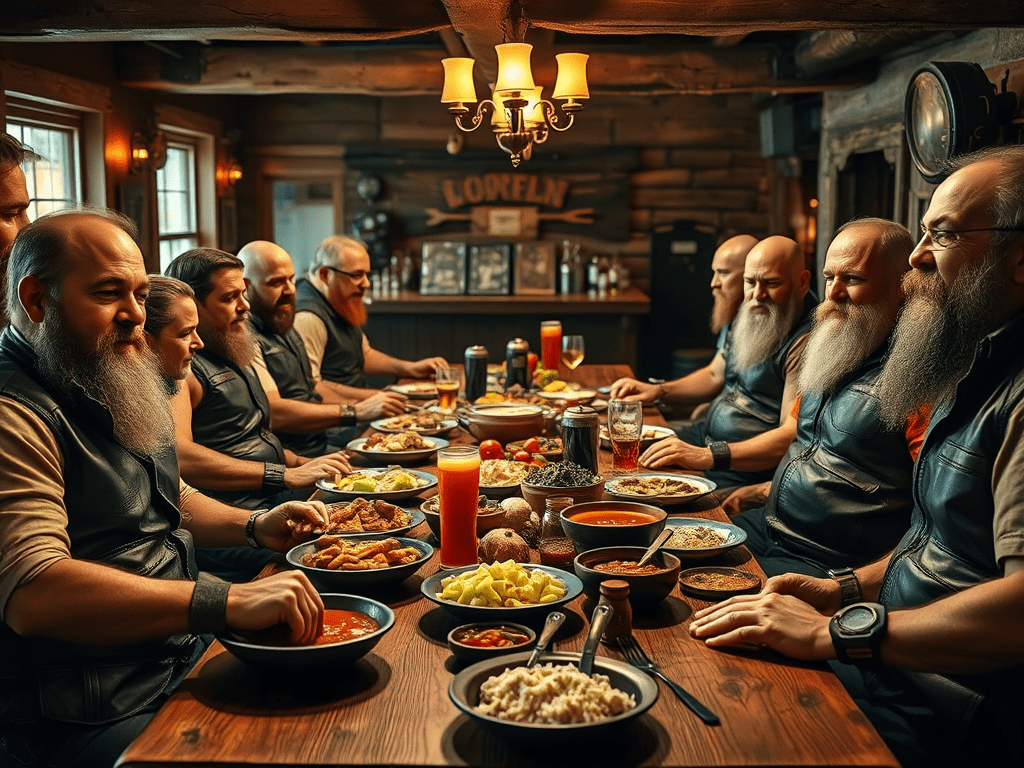
I’ve lived in some places where the word “hospitality” didn’t mean what most people think. It wasn’t always warm cookies on the counter or a welcome sign on the porch. Sometimes it looked like walking into a motorcycle clubhouse where every eye was sizing you up, waiting to see if you respected their space. Other times it looked like sweating over a hot stove, trying to feed a roomful of strangers who didn’t know my name but would remember a taste on their tongue.
Those two worlds, the roar of Harleys and the clang of sauté pans, don’t look much alike at first glance. But they both carried the same truth: hospitality is more than an action. It’s a heart posture. It’s about creating space, whether it’s at a table, in a clubhouse, or in a kitchen, where somebody else feels seen, safe, and honored.
And funny enough, that’s exactly what David was trying to do in 2 Samuel 7.
David had just reached a moment in life that felt like breathing after a long sprint. The wars were quiet. The throne was secure. For once, he wasn’t running from Saul or fighting Philistines… he had rest.
He was finally living in the palace, cedar walls around him, luxury on every side. And while he sat there, probably enjoying a glass of wine and the silence of peace, it hit him: “Here I am, living in a palace of cedar, while the ark of God remains in a tent.”
Think about that. David suddenly felt the weight of disparity. He’s got a palace, and God’s ark, the very sign of His presence, was sitting in a tent. To David, this felt wrong. Unbalanced. Almost dishonorable. So David did what a man of honor would do: he decided to show God hospitality. He told Nathan the prophet, “I want to build God a house.”
It was sincere. It was heartfelt. And it was David’s way of saying, “Lord, You deserve better. Let me give You something.”
That’s hospitality at its core, meeting someone with honor, dignity, and a place to belong.
That reminds me of my years working in motorcycle ministry. Now, stepping into a 1% club’s house isn’t like walking into Sunday school. You don’t knock on the door with a casserole dish and expect a smile. Respect has to be earned, and it shows up in how you carry yourself.
We practiced hospitality by showing up without judgment, by taking the food they offered (whether it was smoked ribs or something a little more questionable), and by listening to their stories without trying to preach them down. We honored them by treating their space as sacred, even if it looked nothing like a church We did what ever we could for them, but most of all we were there for them.
And here’s the thing, they showed hospitality back. In their world, letting us sit at their table, pouring us a drink, making sure no harm came to us while we were in their house, they did what they could for us; that was hospitality. That was them saying, “You’re safe here. You belong here.”
That exchange always stuck with me. We brought what we could, they gave what they had, and in the middle of it, relationships were formed that couldn’t have been made any other way.
David’s offer to God was like that. He was bringing what he could, cedar walls, gold, a house fit for a king, but God’s reply was, “David, I don’t need cedar. I don’t need luxury. What I want is you. And because you offered Me your best, I’m going to give you something greater.”
God’s response through Nathan is both humbling and overwhelming. He basically says, “David, you want to build Me a house? I’ve been moving in tents since Egypt. I’ve never once asked anyone to build Me cedar walls. Instead, here’s what I’ll do for you: I will build you a house. A dynasty. Your name will be great, your throne will endure forever, and from your line will come a King whose kingdom will never end.”
That’s divine hospitality. David offered God a home; God offered David a covenant. David thought temporary structure; God promised eternal presence. David dreamed of giving God a place; God gave David a legacy that would stretch all the way to Christ.
It’s like God was saying, “David, you don’t out-hospitality Me. You don’t out-give Me. You bring Me a cedar palace, and I’ll give you an eternal kingdom.”
That exchange is something I’ve felt in the kitchen too. There are nights where you bleed for the food. You cut, you sweat, you yell, and you push through to put plates out on the pass. That’s hospitality, putting your heart into the dish so someone else feels cared for, nourished, loved.
And then the plate goes out, and the guest takes that first bite. They smile. Their shoulders drop. They taste something that brings them joy. In that moment, everything you poured out comes back to you a thousandfold in the look on their face. That’s the return gift. That’s the exchange.
That’s God with David. That’s God with us. We bring Him what we can, our prayers, our worship, our service. And He brings back more than we could ever imagine: mercy, grace, presence, salvation.
Here’s the truth: whenever we offer God hospitality, He multiplies it. That’s what makes His hospitality so much stronger than ours.
David offered a house; God gave a dynasty.
We offer our broken lives; God gives us eternal life.
We give Him our sin; He gives us His righteousness.
We offer Him our time and service; He gives us His presence and power.
Hospitality with God is never one-sided. You bring Him a tent, He gives you a kingdom. You bring Him bread and fish, He feeds 5,000. You bring Him a cross, He gives you resurrection.
But here’s the part I don’t want us to miss: hospitality isn’t about the stuff. It’s about the relationship. David thought God needed cedar walls, but what God really wanted was David’s heart.
That’s the same in ministry. When we walked into those clubhouses, it wasn’t the food or the space that mattered most. It was the relationship being built. When I cook a meal, it’s not the plate itself that matters, it’s the connection formed across the table.
And with God, it’s not the house we build Him, it’s the heart we give Him. That’s the place He wants to dwell. That’s the true hospitality exchange: we open our hearts, and He fills them with Himself.
All of this points to Christ. Because generations later, from David’s line came Jesus, the King whose throne will never end. And what did Jesus do? He showed us the greatest hospitality of all.
He came into our world. He sat at our tables. He touched lepers, ate with sinners, broke bread with the broken. And then, in the greatest act of hospitality, He laid down His life so that we could have a place at His Father’s table forever.
That’s the fulfillment of God’s promise to David. That’s the “house” God promised: a kingdom, a family, a seat for us at His table.
Don’t ever think your hospitality to God is wasted. Don’t ever think your offering is too small. David’s idea was good, but God’s reply was greater. Our efforts are always returned 1,000X fold when they’re placed in God’s hands.
You can’t out-give Him. You can’t out-serve Him. You can’t out-hospitality Him.
When we open our hearts to Him, He opens heaven to us. When we make space for Him, He makes eternal space for us.
So maybe the question isn’t, “What can I build for God?” but rather, “What part of my life can I open for Him to dwell in?” Because whatever space you give Him, He’ll repay with something greater.
That’s the beauty of divine hospitality. You bring Him your cedar, He brings you His covenant. You bring Him your heart, He brings you His Kingdom.
So how do we take David’s story, my clubhouse lessons, and those long nights in the kitchen, and live them out in our world today? Hospitality isn’t just ancient history, it’s kingdom work for here and now. Here are some ways we can offer God hospitality, and in turn, experience His return gift:
Open your door to others, not just friends, but those who can’t repay you. Jesus said, “When you give a banquet, invite the poor, the crippled, the lame, the blind, and you will be blessed” (Luke 14:13–14).
Make space for God, too. Pray in your living room. Play worship in your kitchen. Invite Him to dwell in the same place where your family eats, laughs, and fights.
Remember that church is about presence, not buildings. Fancy sanctuaries don’t move God, open hearts do. Practice hospitality by greeting, serving, and sitting with people you don’t know.
Be the one who notices the person sitting alone. Hospitality begins with eye contact and a simple “I’m glad you’re here.”
Hospitality can be as simple as buying a meal for a hungry neighbor, listening without rushing, or giving dignity to someone the world overlooks.
Like David with the servant in the ditch (1 Samuel 30), you never know when your kindness will turn into someone else’s chance to show kindness back.
Offer Him time. Make room in your schedule. Just as David wanted to give God a house, give Him a portion of your day. He’ll multiply it with peace and strength you couldn’t have mustered on your own.
Invite Him into your brokenness. That’s hospitality too… saying, “Lord, I’ve got nothing but this mess,” and watching Him turn it into beauty.
Hospitality begets hospitality. David wanted to give God a house, and God gave him a dynasty. Jesus gave twelve men His life, and they turned the world upside down. On the cross, Christ gave us an eternal invitation, and now, we carry that same spirit of hospitality everywhere we go.
So don’t underestimate your offering. Don’t think your “tent” is too shabby for God to dwell in. Bring Him your best, however small it feels. Open the door of your heart, your home, your church, your life.
And get ready, because when you show hospitality to God, He always shows it back, pressed down, shaken together, running over.
Stay Salty
 Salt, Light, & Hospitality