Nobody ever said obedience would be easy, not even once. But if you’ve walked with God long enough, you learn something: obedience might not always make sense on paper, but it always writes a better story.
My parents didn’t leave the Blue Ridge Mountains of North Carolina for Vermont because they wanted a fresh start or a prettier zip code. They weren’t chasing a dream; they were answering a call. God said “go,” and so they did, uprooting everything familiar, trusting that He would provide. It wasn’t easy. The winters were brutal, the culture unfamiliar, and the road ahead often foggy with uncertainty.
But obedience writes stories that comfort never could.
They planted deep roots in rocky soil, and over time, God made it bloom. From that step of obedience came a life overflowing with blessings: a fruitful ministry, six children, eighteen grandchildren, two great-grandchildren, eight in-laws, and countless others who may not share our blood but absolutely share our table. God built a family, a legacy, a testimony, all because they made space for Him through obedience.
And now, that story continues through us.
When my wife and I felt the called to move, we wanted to say yes, but truthfully, we had a very specific place in mind. We dreamed of settling in the Blue Ridge Mountains ourselves, following in the footsteps of my roots, raising our kids where the mist rolls off the peaks in the morning and life moves a little slower.
But God had different plans.
He pointed us not to the hills of North Carolina but to Savannah, Georgia. Not the mountains, but the marsh. Not the quiet hills, but the humid coast. It wasn’t what we envisioned, but we knew what it was:
It was a call.
So once again, with a mix of peace and trembling, we obeyed.
We didn’t come to Savannah because it checked every box. We came because the same God who told my parents “Go” was now speaking to us. And just like them, we’ve found blessing on the other side of that yes.
My wife is thriving, doing what God designed her to do. She’s interpreting, leading, creating opportunities for accessibility, and building a business that helps connect the Deaf and hearing worlds with excellence and compassion. Watching her walk in her calling has been one of the greatest joys of my life.
I’ve found success in the culinary world…. been published, featured on TV, and earned accolades I never chased. But more importantly, I’ve used food as a doorway to ministry, connection, and community. And now, God is calling me deeper.
For years, I’ve carried a word that I’d be a pastor like my father. I ran from it. I wrestled with it. But the time has come, and I’m walking it out, seeing where God is leading me interviewing with multiple churches, preaching the Word, and learning what it means to shepherd with a chef’s heart. Ministry, like cooking, is about feeding people, body, soul, and spirit.
And it all began with a “yes.”
We often think of hospitality as dinner parties and warm welcomes, but real hospitality starts with obedience. It’s about making space for God to move, even when the plans change, even when the path looks unfamiliar. That’s how legacies are built. That’s how families are grown. That’s how mountains are traded for marshlands and still become holy ground.
My parents’ obedience opened a door that has blessed generations.
Now, my family and I are walking through our own. We may only have three kids so far (but hey, there’s still time), and we’re still finding our footing. But we’ve made space for God in our lives, our work, our calling, and He’s filling it.
So no, we didn’t end up where we wanted. But we landed where we were called.
And when you choose obedience over comfort, you don’t miss out, you step in.
let’s be real, 1 Samuel 9 starts off with what sounds like the biblical version of a Craigslist “Lost & Found.”
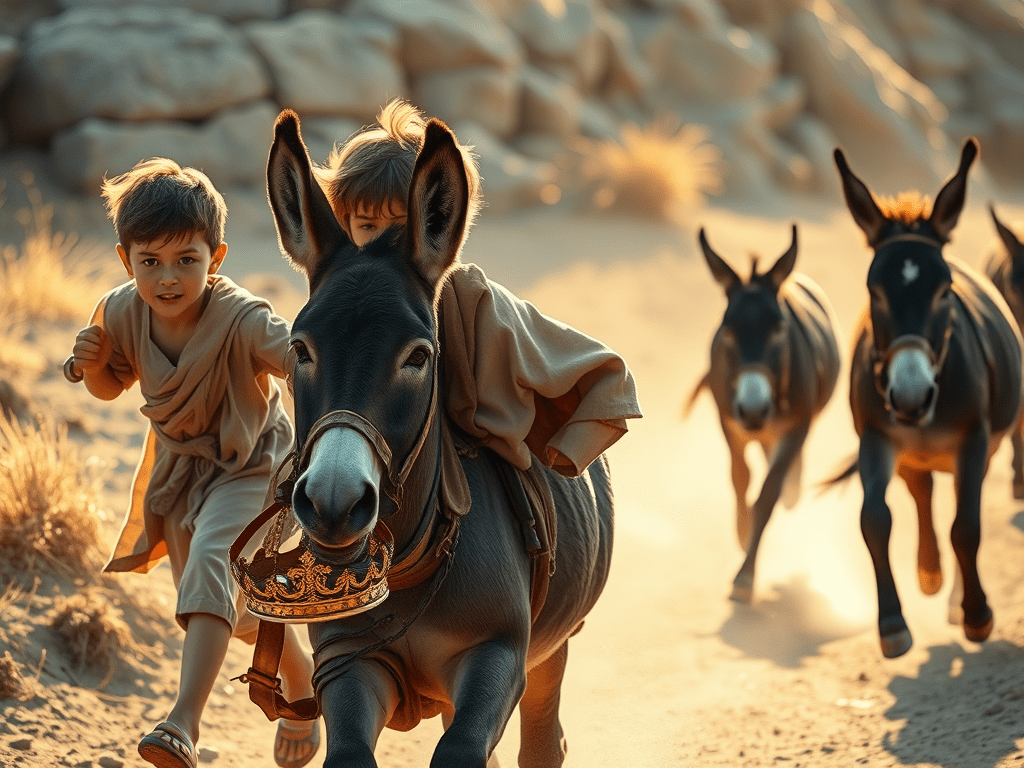
Picture this: Saul is out chasing his dad’s donkeys. That’s it. No dramatic battlefield. No burning bush. No angelic choir in the background. Just a grown man traipsing through the countryside looking for livestock. Not exactly the glamorous entrance you’d expect for Israel’s first king, right?
But here’s the thing: this so-called wild donkey chase wasn’t about donkeys. It was about obedience. It was about God taking something small, mundane even; and using it to kick off something massive. Because in God’s kingdom, obedience in the little things is the gateway to destiny. And when obedience meets hospitality? Oh man, the whole kingdom shifts.
Saul was just doing what his father asked. Nothing heroic. Nothing flashy. He wasn’t out to win a war or start a revival. He was simply being a faithful son.
And it was that very act, quiet, faithful, unseen, that put him in the path of divine destiny. If he had blown off the task, rolled his eyes, and said, “Not my monkeys, not my donkeys,” he might’ve missed the entire calling.
Sometimes the first step toward your purpose looks a whole lot like errands.
That’s what we so often forget. We keep waiting for God to move through fireworks and fanfare, but He shows up in the Tuesday afternoon errands. The unspectacular faithfulness. The donkey chases. Because God’s not looking for the spectacular. He’s looking for surrender.
Now here’s where it gets good. After a few days of searching, Saul’s ready to throw in the towel. But his servant, the real MVP in this story, pipes up and says, “Hey, there’s a man of God in this town. Let’s go talk to him.”
Translation: “We’ve got no clue what we’re doing. But maybe someone who listens to God does.”
This is what I love: it wasn’t just obedience to his father that changed Saul’s life, it was obedience to a suggestion. A moment of humility. A willingness to say, “Maybe I don’t have the answers, but I know someone who might.”
That little act of not giving up, of being willing to ask for help, led Saul straight into the arms of divine appointment.
Now let’s talk about Samuel for a second. This guy had been hearing from God since he was a boy. He wasn’t new to obedience. But here’s the powerful thing: he didn’t just hear God, he made room for what God said. His obedience wasn’t just in prophecy; it was in hospitality.
Samuel could’ve seen Saul as just some sweaty, dusty kid chasing animals. He could’ve said, “Come back later, I’ve got real prophetic business to attend to.” But he didn’t.
Instead, Samuel leaned into what I call hospitality as obedience.
He welcomed Saul. He fed him. He honored him. He made a seat at the table. And then—he anointed him. Just like God had told him.
See, Samuel didn’t know the full backstory. He didn’t get a PowerPoint presentation explaining Saul’s future. He just trusted the voice of the Lord enough to open his door and fire up the stove.
That’s the thing we miss about hospitality sometimes. We’ve reduced it to casseroles and clean bathrooms and polite conversation. (All good things. Praise God for casseroles.)
But hospitality isn’t just about being nice. It’s about being available. It’s about creating sacred space for God’s plan to walk in, dirty shoes, donkey breath and all.
We want revival, but we don’t want the inconvenience of setting another plate at the table. We want God to move, but we don’t want to be interrupted.
But Samuel? He was interruptible. And that made all the difference.
What If Samuel Had Said No?
Let’s be honest: Samuel had every excuse to shut that door. He could’ve said, “I’m tired. I’m fasting. I’ve got a scroll to finish. I already hosted someone last week.” What if he’d told Saul to try the next town over?
He would’ve missed the moment God had been orchestrating since before Saul ever lost a donkey.
And if that’s true for Samuel, what about us?
How many divine appointments have we missed because we were too tired, too distracted, or too focused on ourselves to notice the wandering soul at our gate? How many future leaders never got their word because we didn’t want to mess up our schedule or reheat the leftovers?
Listen, God is always working behind the scenes. But He often looks for people who are willing to open the front door.
When Saul sat at that table, he had no idea he was about to become king. He thought he was getting a snack. Instead, he got a calling. Samuel didn’t just hand him a meal. He handed him clarity. He handed him confirmation. He handed him kingdom.
And every ounce of it started with someone saying yes to showing up and yes to opening the door.
Let that sink in: The world shifted because one man obeyed his father, and another man set the table.
That’s the Kingdom of God, right there
The Big Question
So here’s what we’ve got to ask ourselves:
What might we have missed by not showing hospitality?
What calling didn’t get confirmed?
What leader didn’t get anointed?
What weary traveler didn’t get fed… spiritually and physically… because we were too distracted, too self-focused, or too afraid to obey?
Hospitality is more than kindness. It’s spiritual warfare. It’s kingdom work. It’s aligning ourselves with the heart of God and saying:
“I’m ready. I’ll make room. I’ll set the table.”
Even if it looks like a wild donkey chase at first.
Because you never know who’s going to walk through that door. It might be someone God’s about to raise up. It might be someone who just needs rest before their next assignment. Or it might just be someone looking for help, and in that very moment, the kingdom shifts.
Let’s Be People Who Don’t Miss It
Let’s obey in the small things, even when it feels ridiculous.
Let’s welcome the wanderers, even when we’re tired.
Let’s feed the ones chasing donkeys.
Let’s anoint the ones God is raising up.
Let’s trust that God knows what He’s doing, even when it starts with lost livestock.
Because when obedience and hospitality collide, heaven moves.
And the world will never be the same.
Stay Salty
 Salt, Light, & Hospitality