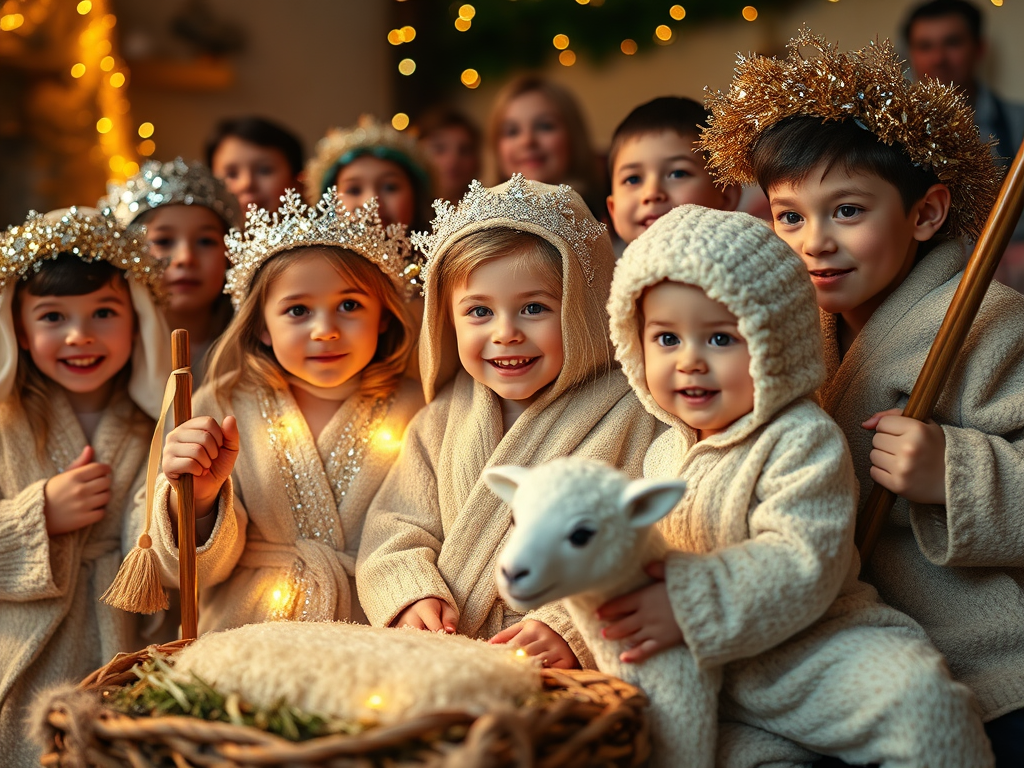
Every year, my home church hosted a Christmas Eve White Gift Service. It was one of those deeply cherished traditions that felt like stepping into a warm, familiar storybook. The centerpiece of the evening was always the living nativity, performed by the children of the church. To call it a “production” might be a stretch—it was more like a holy chaos with tinsel halos and bathrobe shepherds. But it was the kind of chaos that made your heart swell with joy.
One year in particular stands out vividly in my memory. My sweet little girl, along with her angelic squad of friends, donned glittery tinsel halos and glided down the aisle as if heaven itself had commissioned their performance. Their eyes sparkled with the innocence and wonder only children can muster on Christmas Eve. Meanwhile, my nephew took on the role of a shepherd. Clutching his staff like he’d just wrangled a flock of real sheep, he stood proud, fully embodying his part.
And then there was the lamb. A very distracted, very two-year-old lamb.

This little boy—a church families youngest—had been roped into the role mostly because someone needed to crawl around in fuzzy pajamas. But rather than meekly following the shepherds, he spent most of the service alternating between trying to remove his lamb ears and making a break for the Christmas tree in the corner. At one point, he plopped down center stage, happily chewing on what I’m pretty sure was part of the manger, all while waving to people and trying to grab the lit candles. The audience, of course, adored him. There’s something about a toddler in costume that makes even the most solemn congregants grin from ear to ear.
The culmination of the service was always the giving of symbolic gifts to Jesus for His birthday. Each family brought a simple piece of paper with something from our life that we want to give to Jesus—a “white gift”—which was placed at the foot of the altar. Watching my friends and family lay their small offerings before the nativity scene filled me with a quiet kind of reverence. It was a moment to pause amidst the busyness of the season and reflect on the heart of Christmas.
But as my thoughts wandered, I couldn’t help but think of the people in my life who shared their birthdays with this festive season. My dad, my father-in-law, and my brother-in-law all have birthdays that fall inconveniently close to Christmas. And by “inconveniently,” I mean they’ve been shorted on birthday celebrations more times than I can count.
Growing up, my dad’s birthday presents were often wrapped in leftover Christmas paper. My father-in-law’s birthday cakes sometimes might as well of had poinsettias along with candles. And my brother-in-law? Well, his birthday parties were usually merged with whatever family Christmas gathering was already on the calendar.
I’ve often wondered whether it’s a blessing or a curse to share your birthday with the most celebrated holiday of the year. On one hand, the entire world seems to be in a festive mood. There are lights, music, and feasts galore. But on the other hand, does your special day get lost in the shuffle? Does the joy of the season overshadow the celebration of you?
As I watched those children every year, their faces glowing in the candlelight of the sanctuary, made me realized that perhaps it depends on perspective. Sharing your birthday with Christmas might feel like being a shepherd—humble, overshadowed by angels and kings—but it also means your day is woven into the greatest story ever told. To be celebrated alongside the birth of Christ is, in its own way, a profound honor. It’s a reminder that the best gifts aren’t wrapped in paper but are found in love, family, and the shared joy of the season.
That Christmas Eve, as the last notes of “Silent Night” filled the church and the children paraded out in their mismatched costumes, I held onto the sweetness of the moment. My little girl, my nephew, and yes, even the distracted lamb, had reminded me of the beauty of simplicity. And as I thought about those December birthdays in my family, I decided that maybe—just maybe—it’s not about whether you’re shorted or celebrated. It’s about the love you give and the love you receive, no matter the season.
And then there’s Jesus—His first birthday had angels singing His praises, and His last was marked by being beaten and put to death. At this point, you’re probably looking up and saying, “Wait a second, that’s Easter, not Christmas.” To which I’d reply, “Ah, you must not have done much sheep farming, have you?”
Ah, the birth of Jesus—the story that’s been told and retold so many times it feels like we were there. Cue the shepherds, the angels, and that star brighter than your neighbor’s Christmas light competition. But beneath all the cozy nativity vibes lies a narrative packed with symbolism, unexpected heroes, and a hospitality so radical it changes the way we’re called to live.
So, grab a cup of coffee (or a mug of eggnog if you’re feeling festive), and let’s dive into the deeper layers of this timeless story.
When Was Jesus Born, Really?
Spoiler alert: it probably wasn’t December 25th. Most scholars agree that Jesus was likely born in spring, and there’s biblical evidence to back this up. Remember that verse in Luke 2:8? “And there were shepherds living out in the fields nearby, keeping watch over their flocks at night.” Here’s the deal: shepherds didn’t hang out in fields during winter—too cold. Instead, this detail points to lambing season, which happens in the spring.
And speaking of lambs, Bethlehem was the place for producing sacrificial lambs for the temple. These lambs had to be flawless—no blemishes, no imperfections. The shepherds around Bethlehem weren’t just casual caretakers; they were pros, tasked with protecting these lambs and preparing them for their sacred purpose.
Now, think about it: Jesus, the Lamb of God, was born in Bethlehem, laid in a manger, and wrapped in swaddling cloths. Sound familiar? It should. This was exactly how sacrificial lambs were handled—born in caves, wrapped up tight to protect them, and placed in stone mangers to keep them safe. The symbolism is about as subtle as a trumpet blast. From the moment He entered the world, Jesus was marked for a divine purpose: the ultimate sacrifice for humanity.
Let’s talk about the shepherds. We tend to picture them as peaceful, pastoral figures with halos and well-behaved sheep. Reality check: these guys were gritty, smelly, and considered the outcasts of their time. They weren’t rolling up to temple worship because their line of work made them ceremonially unclean.

But here’s the twist: these same shepherds were entrusted with the most important job in Bethlehem—protecting the sacrificial lambs. And when the angels showed up to announce Jesus’ birth, they weren’t just cluing the shepherds in on a cute baby in a manger. They were calling them to witness and guard the Lamb of God Himself.
Now, add this layer of drama: King Herod had issued a terrifying decree to kill every boy under the age of two. The city would’ve been crawling with Roman soldiers enforcing the census and keeping tabs on the population. Bethlehem wasn’t just bustling; it was a powder keg.
Knowing this, the shepherds’ role takes on even more significance. These men, who were already skilled at protecting lambs, now had an even greater charge—to watch over the newborn Lamb of God in a city packed with danger. Their presence at the manger wasn’t just a cameo; it was an act of courage and devotion.
We can’t forget about the innkeeper. Sure, he doesn’t get much screen time in the Gospel account, but his role is crucial. Overcrowded conditions, Roman guards everywhere, and no room at the inn—sounds like a recipe for chaos. Yet this unnamed host made room for Mary and Joseph in a stable.
Was it ideal? Nope. Was it necessary? Absolutely. The stable became a sanctuary, and the innkeeper’s simple act of hospitality reminds us that making space for others—even when it’s inconvenient—is at the heart of Christ-like love.
The Christmas story overflows with hospitality. The shepherds left their fields to celebrate Jesus. The innkeeper found room when there was none. Even the angels got in on the action, throwing the ultimate heavenly concert to announce the birth of the Savior.
But hospitality isn’t just about making people comfortable. It’s about creating a space where they can encounter grace, joy, and love. Think about the shepherds again. They didn’t just show up to admire the baby; they stayed to protect Him, fulfilling their role in the story. Their actions challenge us to do the same—to stand up for the vulnerable and offer refuge to those in need.
So, what does this all mean for us? How do we carry the spirit of the nativity beyond the holiday season?
Be Present: In a world that’s constantly on the go, giving someone your full attention is a gift that speaks volumes.
Make Space: Hospitality doesn’t require a Pinterest-worthy home. It’s about opening your heart and sharing what you have, no matter how humble.
Serve with Courage: Like the shepherds, step up to protect and care for those who need it most, even when it’s risky or inconvenient.
Celebrate Together: Hospitality isn’t just about meeting needs; it’s about creating moments of joy and connection that point back to God’s love.
Jesus’ birth wasn’t just a historical event; it was an eternal invitation. From the shepherds guarding the Lamb of God to the innkeeper making room in a stable, every act of hospitality in the nativity story reflects God’s radical love and grace.
So, as we celebrate His birth this year, let’s remember the deeper call of the Christmas story. Let’s embrace a lifestyle of welcome, protection, and love—one that points others to the ultimate Host who invites us all to His table of grace.
Because at the end of the day, the nativity story isn’t just about a baby born in Bethlehem. It’s about a God who made room for us—and calls us to do the same for others.
 Salt, Light, & Hospitality